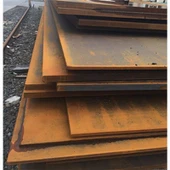
S500Q and S620Q are European standard (EN 10025-6) High Strength Low Alloy (HSLA) structural steel plates, known for their high yield strength (500 MPa for S500Q, 620 MPa for S620Q) and superior toughness, delivered in a Quenched & Tempered (Q+T) condition with excellent low-temperature impact properties, making them ideal for heavy construction, cranes, and machinery requiring strength and weldability.
Chemical composition of S500Q steel plate
| C | P | S | N | B | |||
| 0.20 | 0.80 | 1.70 | 0.025 | 0.015 | 0.015 | 0.005 | 1.50 |
| V | |||||||
| 0.50 | 0.70 | 0.06 | 2.0 | 0.05 | 0.12 | 0.15 |
|
S620Q |
||||||||
|
C |
P |
S |
N |
B |
||||
|
S620 Q |
0.20 |
0.80 |
1.70 |
0.020-0.025 |
0.010-0.015 |
0.015 |
0.005 |
1.50 |
|
V |
|
|||||||
|
0.50 |
0.70 |
0.06 |
2.0 |
0.05 |
0.12 |
0.15 |
|
|
Mechanical properties for S500Q steel plate:
| t<=50 | 50<> | 100<> | t<=50 | 50<> | 100<> |
| 500 | 480 | 400 | 590-770 | 590-770 | 540-720 |
|
S620Q |
||||||
|
|
||||||
|
S620 Q |
-20 |
30J |
||||
|
3<> |
620 |
700-890 |
15 |
-20 |
30J |
|
|
50<> |
580 |
700-890 |
15 |
-20 |
30J |
|
|
100<> |
560 |
650-830 |
15 |
-20 |
30J |
|
Standard: EN 10025-6 (for Quenched & Tempered steels).
Delivery Condition: Must be supplied Quenched and Tempered (Q+T).
High Strength: S500Q has a minimum yield strength of 500 MPa, while S620Q has 620 MPa.
Low-Temperature Toughness: Both offer good impact energy at low temperatures (e.g., -20℃ for S500Q, with 'L' variants for -40℃/QL, -70℃/QL1).
Applications: Used in welded, bolted, and riveted structures, heavy machinery, bridges, and cranes where high strength-to-weight is crucial.
S500Q vs. S620Q
S500Q: Min Yield 500 MPa, Tensile 590-770 MPa, good for -20℃ impacts (S500QL for -40℃).
S620Q: Min Yield 620 MPa, higher strength than S500Q, also offers 'QL' and 'QL1' grades for enhanced low-temp toughness.